By Jessica San Luis
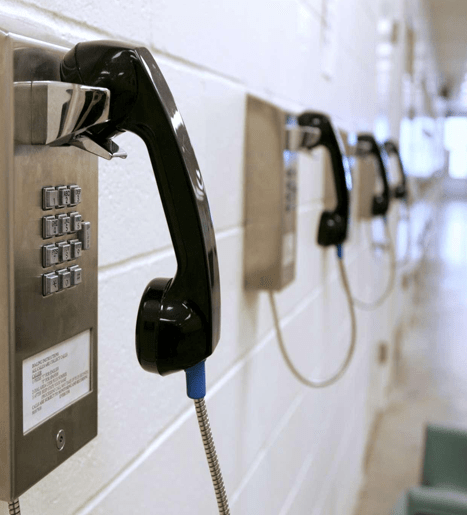
Once upon a time, the only means by which incarcerated men and women were able to communicate with their loved ones was to place a collect call from a pay phone and hope that someone answered on the other end. While those days are long gone, with the introduction of third-party communications companies like GlobalTel Link, JPay and Securus Networks, communications between incarcerated individuals and their loved ones remains problematic at the very least. Plagued by network failures, connectivity issues and extortionist prices, the prison communications game is anything but fair. And for the more than 2 million incarcerated men and women in the United States, the constant breakdown in the lines of communication only exacerbates the trauma of prolonged incarceration.
Upending the Playing Field
On September 10, 2021, the Sacramento County Superior Court in Northern California set aside an award by the state Department of Corrections and Rehabilitation (CDCR) of a contract to Global Tel Link Corporation (GTL) for telecommunications services for California prisoners. The ruling in Securus Techs., Inc., v. Cal. Dep’t of Technolog., (Cal. Super. (Sacramento Cty.), Case No. 34-2021-80003594) dealt a blow to GTL’s rollout of new tablets to state prisoners under the initial contract, which set off a domino effect for similar communications companies vying for the same government contracts. Securus Technologies, a newcomer to the game, was also stymied in its effort to expand a pilot program launched at five state prisons to disseminate media tablets to incarcerated men and women. Ultimately, GTL prevailed in the contracts lawsuit, but the litigation revealed significant information about the communications business and the costs passed on to families.
So what is at stake in this communications game? For starters, the lucrative market for prisoners’ media – gaming, reading and listening material – delivered through electronic tablets much like an iPad and can also be used to make phone calls to loved ones on the outside. In fact, the tablets – which were rolled out en masse around 2016, once made up the lion’s share of profits for prison communications companies. But several years after the rollout, the Federal Communications Commission (FCC) sought to reign in the racket due to price-gouging and exorbitant cost markups for profit. And while the individual terms of voluminous contracts like those sought by these communications giants are often largely irrelevant, in this game – where the customers are almost entirely incarcerated individuals and low- to mid-income families – hard costs and profit markups are extremely significant.
The Request for Proposals (RFP) issued by CDCR in 2020 to solicit bidders for these coveted communications contracts set a “not-to-exceed” (NTE) limit for specific costs. One NTE – for phone calls from incarcerated men and women to their loved ones – was set at $.05 per minute. Which may seem more than reasonable at first blush, especially given the number at the bottom of the average cell phone bill. But if we break down that cost, taking into consideration that the average American spends just under 3 hours per day on phone calls, the costs start to add up. If an incarcerated individual wanted to spend even half that time on calls with loved ones, the cost would be $4.50 per day. Multiply that by 30 days, and the cost of minimal phone time with an incarcerated loved one comes to $135.00 per month. But wait… there’s more.
In Washington state, Securus Technologies reigns supreme. Providing tablets to incarcerated individuals as a means to purchase songs, books, magazines and movies, and facilitating “video visits” via communal machines in prison day rooms, Securus describes itself as being at the forefront of rehabilitative support programs. But in reality, the self-aggrandizing accolades are just that. And when it comes to facilitating communications for millions of incarcerated men and women, Securus’ main concern is clearly not their health, well-being and happiness. It’s cold, hard cash and lots of it. Remember that NTE of $0.05 per minute? Somehow, that cost was passed on to consumers at a rate of $0.07 per minute. And while two cents does not seem like an extreme gouge to most people, if we do the math, it really is.
Securus limits phone calls to 20 minutes. Any call, at any time of day. Which means that no matter what is being discussed, or how urgent the subject matter may be, when the clock strikes 20, the call cuts off. For this service, Securus charges $1.35, which works out to just about $0.07 per minute. If the call drops after the first minute? The party is still charged a flat rate of $0.25. And if an incarcerated individual wants or needs to communicate with loved ones at the well-below-average rate of 2 hours per day, the cost to his or her family or friends tops out at $5.40 per day or $162.00 per month. Video visits, which are scheduled well in advance and only for 30 minutes per visit, cost $4.95 through Securus. Again, these costs may seem minimal, but look at it this way: if you wanted to spend an hour total during any given day on FaceTime, you would have to shell out nearly $10.00 for the privilege. If our cell phone carriers charged these rates, the average monthly cell phone bill would exceed $900.00.
And these costs don’t even include media purchases ($9.00 for one movie, $15.00 for one album, and $1.15 for one song), a markup of more than 35%. They also don’t include the cost of stamps to send emails. That’s right, there is no free GMail in prisons. Each basic email under Securus’ contract costs 1 stamp. An email with a return stamp for the incarcerated loved one costs 2 stamps. An email with photos attached (with a limit of 5 photos per email) costs 6 stamps. And with a book of 60 stamps costing $10 with a $2 processing fee, the costs add up. In fact, it is not at all out of the ordinary for the family member of an incarcerated individual to spend $400.00 to $600.00 every month just to maintain regular contact.
Paying for Love
Research has shown time and time again that access to family members and friends necessarily improves the lives of incarcerated individuals. In fact, these support networks actually reduce the overall recidivism rate and ensure far greater success upon release as well. While the average national recidivism rate is 43.3%, and an average of approximately 300,000 released prisoners can be expected to recidivate each year, studies have consistently shown that prisoners who maintain close contact with their family members while incarcerated have better post-release outcomes and lower recidivism rates. (Friedmann, Alex, Lowering Recidivism through Family Communication, Prison Legal News, April 15, 2014).
Companies like Securus Technologies use this demographic to bolster their ad campaigns, boasting that their communications network promotes healthy relationships between incarcerated individuals and their loved ones. But is the service truly even functional? Loved ones of incarcerated individuals report on average that every third call through the Securus Technologies network fails. Similarly, roughly half of the video visits scheduled by loved ones with incarcerated individuals either freezes mid-stream, ends entirely or is interrupted for minutes at a time due to equipment or connectivity issues. In addition, significant technical issues are commonplace at the facilities serviced particularly by Securus Technologies, leaving incarcerated individuals without a way to contact their loved ones for hours, days or even weeks at a time. One example of this was a catastrophic failure of the Securus Technologies network in mid-March, 2023, affecting primarily out-of-state inmates (also called “boarders” by the Washington DOC). The network failure caused all boarders’ profiles – of which there are thousands – to be deleted entirely from the Securus Technologies network. This left thousands of men and women in several states without a way to call, message or see their loved ones for nearly two weeks.
You would think, with all of these technical issues, that Securus Technologies would provide substantive customer support to address paying consumers’ concerns. But this is far from reality. Securus Technologies’ call center operators are often completely in the dark about up-to-date technical issues and never have information on a timeline for remedies or fixes. Often, when consumers contact customer support, their concerns are rudely dismissed, and they are told that there is no information to be provided to them. One customer reported that when she asked to speak with a supervisor regarding the nearly two-week-long issue in Washington, the customer support operator threatened to close and delete her account. Similarly, Securus Technologies refuses to refund consumers’ money in situations that clearly warrant it, including dropped calls, interrupted or terminated video visits, and media that never downloads after purchase. There is no direct line to contact Securus Technologies’ billing department, only an email in the mobile and online application that often does not work, and is almost never answered. And while many of these issues are not unique to Securus Technologies, when a company is tasked with providing support to a marginalized population, the onus is on that company to protect those consumers from the exigencies of mobile technology.So what is the human cost here? Imagine waiting for a loved one who needs your support – or whose support you need – for hours, days and weeks on end without a way to find out if that person is okay? Imagine trying to have a peaceful phone call with your spouse but the call drops multiple times and the connection is so poor that only every other word is audible? Imagine having to report an emergency to your loved one, but being unable to contact them because the only means of communication relies on a company and a network that is faulty at best? The damages here are emotional distress, unmitigated stress, and psychological strain. For a population of incarcerated men and women – who are already grappling with stress, anxiety, depression and often mental health or addiction issues, the cost of substandard communications plagued with near-constant technical issues is far too high.



 Behind the Wall: Stories From the Inside
Leave a comment